
The Welsh 3000ers. Expedition training?
Written by Tom Briggs, October 2021
How to train for a mountaineering expedition? In addition to climbing, most people walk, scramble, run and bike. Or at least, that's what one of our recent surveys found. Here, Tom Briggs, discusses how a challenge such as completing the Welsh 3000ers is a great way to test the fitness and mental strength required for a big summit day in the Greater Ranges.
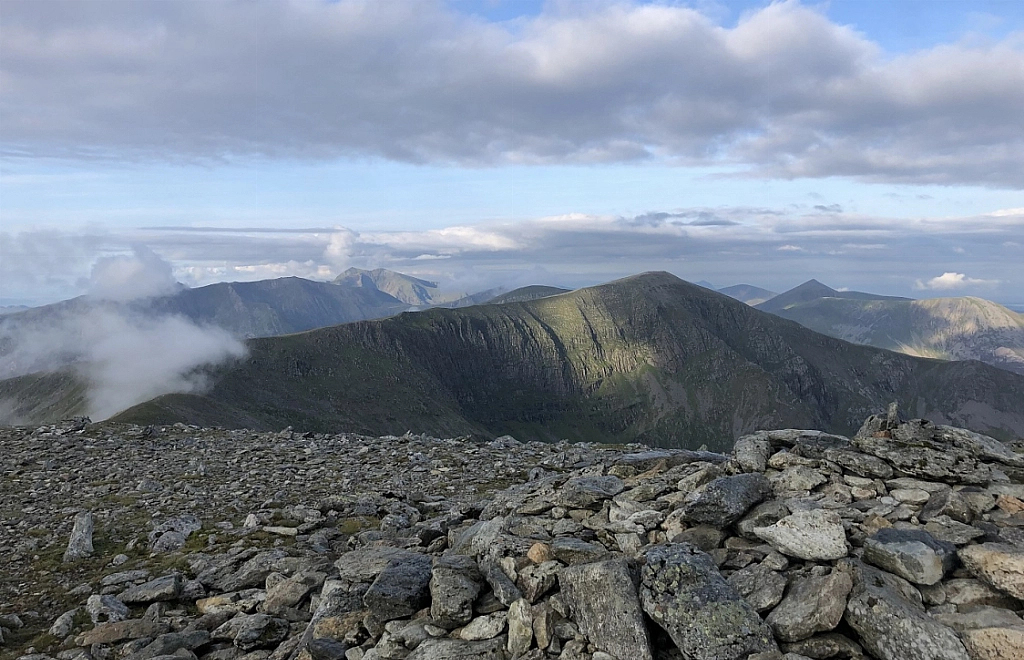
If you've not heard of the Welsh 3000ers, it's 14 summits over 3,000 feet, all of which are in Northern Snowdonia. Completing them in under 24 hours is a classic hill walking challenge. Running them is also popular, with the record from Yr Wyddfa (Snowdon) to Foel Fras standing at an incredible 4 hours and 10 minutes!
In August this year I had the opportunity to attempt the challenge going from north to south. This involves tackling the quiet Carneddau range first, before descending into Ogwen, ticking off Tryfan and the Glyders to finish with a final climb up Crib Goch and along to Yr Wyddfa. I opted to do the journey 'solo self-supported', that is, with one drop bag of food and water pre-stashed in Nant Peris and timing the start of my day to coincide with the Ogwen snack bar opening, where I could get a breakfast coffee and pasty.
A taxi dropped me off at Aber Falls car park at 5am and I headed into the Carneddau via Llyn Anafon. For the next 4 hours I didn't meet a soul, just wild horses and sheep. The descent down the rocky south ridge of Pen Yr Ole Wen involves some scrambling and it is this sort of ground that is a feature of the day. I was 'running' the 3000ers, but there's so much rocky ground underfoot that even on some of the flatter sections across the Glyders it's difficult to move at any pace. But this ability to move across scree and rock confidently and efficiently is incredibly useful on any mountaineering expedition. Thankfully I was carrying a lot less than I would on a climb!
Once stocked up in Ogwen I took the steep path up Tryfan. Tryfan is such a brilliant mountain for training for the Alps and the Greater Ranges, being steep and it's rocky. The north ridge is an absolute classic scramble, but I was happy to follow easier ground given I was only half way through my day. From the summit you descend a little and continue up Bristly gully, which leads you up Glyder Fach. I hugged the right side of the gully, avoiding most of the loose scree. Again, this ascent is perfect training for the kind of moraine you often deal with on big mountains before getting established onto the snow and ice. Careful footwork and route choice is required.
The weather all day had been perfect, with no wind and cloud cover. Despite this, I did have some cramping as I started to climb up Y Garn, though I kept this at bay with electrolytes and some more food. Pushing your body on a big day such as this can be a useful test run. Sweating buckets isn't something I associate with big mountains, but you can still get a good feel for what foods you can stomach when your body needs calories. Whether it be gels, jelly babies or salted snacks, it's good to know what you can get down when you're struggling.
By the time you descend into Nant Peris, it feels like you've already done a very big day. I arrived at around 2pm and had been on the go for 9 hours. Most people do the Welsh 3000ers heading south to north, so tiredness and mental fatigue would start to be felt once they reach the Carneddau. Travelling in that direction the steepest ascents/descents and most technical ground has already been completed. For myself, I was about to head up Crib Goch, shrouded in clag! I jogged up the Llanberis Pass then struck off up the hillside in the direction of the north ridge gully beside Craig y Rhaeadr. At this point a marathon in terms of distance was in the bag. I reached the base of the north ridge of Crib Goch and followed this to the main ridgeline going east to west.
The mental side of climbing big mountains is just as critical as the physical side. We're just not used to having to be 'on the go' for so long and to keep pushing onwards and upwards when normally we'd already be sat in the café reflecting on a good day out. 11 hours in and I was crossing Crib Goch on my own in the gloom. Care was required. It started to rain as I continued towards Garnedd Ugain and the ridge seemed to go on forever.
By now I was ready to finish and as the cloud parted it was a welcome sight to see the hordes of people reaching the summit of Yr Wyddfa on the tourist path. I texted my wife from the summit, then joined the masses in the descent down to Llanberis. In total it had been a 52Km journey with 4000m of ascent and descent. How did it compare to a big day on a Himalayan Peak? It compared very well I think, and I would urge anyone looking to climb, for example, Aconcagua, Denali, or a Himalayan 7000er to put in some 12+ hour days in the UK on similar terrain to that which is encountered on the Welsh 3000ers. The scrambling over rock, the scree and the mental fortitude required to keep moving forwards, even if it feels very slow, will stand you in good stead for the high summits of the Greater Ranges.
How to do it?
The Welsh 3000ers is a linear route, so whether you go south to north or north to south, you're going to need to organise transport. A good option is to get a support team who can drop you off at the start, meet you at the road crossings and pick you up at the end. Navigation can be tricky in poor weather, especially in the Carneddau. You'll also be much slower if it's at all wet underfoot. If possible, try and pick a clear day as you will enjoy the journey so much more. If you want to do it as a guided trip, then get in touch.
Categories
- Announcements (0)
- Blogs (0)
- News (0)
- Trip Reports (0)
- Articles (0)
Archives
- April 2026
- March 2026
- February 2026
- January 2026
- December 2025
- November 2025
- October 2025
- September 2025
- August 2025
- July 2025
- June 2025
- May 2025


