
Ecuador, 2003 Antisana Charity Expedition.
Written by Team Member, January 2004
Mountaineering is essentially a selfish activity. Occasionally opportunities arise where one can put something back into the mountain regions. This year Jagged Globe organised a Charity Expedition to climb the remote and rarely visited Antisana (5,758m). The money raised from the expedition will be donated to the Happy City Orphanage in Ambato, South of Quito, in the hope that we can do something to make a difference to the lives of Ecuador's street children. The orphanage is part of The Daniëlle Children's Fund, a small private foundation in Europe, which tries to help children in Nepal and Ecuador by various means.
Eleven of us arrived in Quito in early November 2003. In Ecuador there is easy access to some fairly high mountains. However you need to acclimatize: for our first step in this process we climbed Pasochoa (4,200m). This has a interesting caldera; its steep northern slope has a wet micro climate and interesting vegetation. It is a designated nature reserve and we watched condors flying overhead. The ascent starts from quite high on the pasture land (páramo). Our approach was from the less steep south side. Whymper, who made first ascents of many of Ecuador's 5000m summits including Antisana in 1880 was not impressed: "From my mountaineer's point of view, some of these peaks 13,000 ft and upwards in elevation were comptemptible, for all appearances, by exercising a little ingenuity, one could ride to their summits on the back of a mule or donkey". Our next step was the central summit (4,634m) of Rumiñahui meaning Stoneface after the eponymous Inca general. This is more interesting from a climbing view point with a steep scree slope and some scrambling to the summit. A donkey would struggle getting to the top of this one.
After a visit to the orphanage we moved on to an idyllic camp at 3900m on the eastern slopes of the Illinizas to attempt some more interesting climbs. Illiniza Norte (5,126m) has no glaciers and is an interesting scramble (for a description see Ecuador's Volcanoes, Newsletter 138 Summer 1998). Illiniza Sur(5,263m) was deemed too dangerous on account of the receding glacier and associated stone fall. Our main objective Antisana, meaning mountain towards the rising sun, by virtue of its eastern aspect is approached via Pintag. Its eastern slopes decend to the Amazon basin. This is one of the most heavily glaciated mountain masses near the equator. From the road head we walked to the edge of the terminal moraine where we set up tents. We retired early to sleep for a typical Ecudorian early start at 1am. Our sleep was occasionally disturbed by a bizarre swooshing noise upon which was superposed some bird sounds. The Ecuadorians dismissed this as the wind but at least one team member was discouraged from visiting the toilet tent in the dead of night. Another Englishman who became a legend in his own lifetime was Yossi Brain who wrote the 2000 climbing guide to Ecuador. He guided in Bolivia and Ecuador but was killed by an avalanche in Bolivia's Apolobamba range. One of his favourite summits was Antisana and some of his ashes are scattered there. According to Brain the Andean Snipe is nocturnal and produces a whirring sound like falling rocks; maybe this is what we heard?
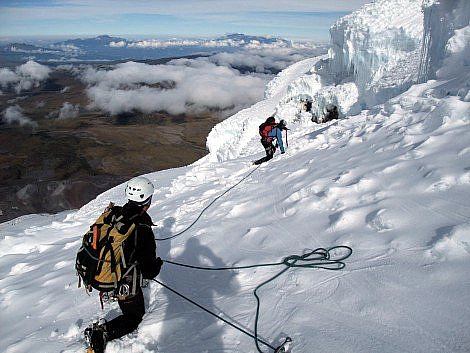
After our early start we climbed over the moraine to the glacier where we roped up and donned helmets. I was in a rope of three at the back of the caravan and was initially surprised by the slow pace of the lead teams: apparently they heard a sharp crack and we were worried about avalanche risk, however a section through the glacier surface layers suggested a stable snow pack. We continued straight up to at about 5,600m when the first band of seracs was encountered. Whymper failed to climb the summit of Illiniza Sur because of the summit cornice of a "strange and embarrassing description". These "Hongos" seem to be characteristic of summit glaciers in Ecuador and are probably caused by the high equatorial sun. To paraphrase him: "with the exception of Illiniza, they were not found at the very highest parts of other mountains including Antisana, but on their lower peaks". Whymper and the Carrells though repelled by the hongos on their first attempt on Antisana succeeded on their second despite premonitions of an avalanche, after having, like ourselves heard a loud crack. According to Brain the summit bergrschrund on the West Face Direct route became very wide and impassable in 1999. Several days earlier our guides had made recces of both this and the more southerly ordinary route without success so our proposed route was a line in between these two. We were able to traverse the initial serac band by entering the crevasse system and climbing out up a 45° ramp. However the summit was surrounded by high ice cliffs that proved impenetrable. Nevertheless the expedition was very enjoyable and raised about $15000 for the orphanage.
John Hardwick, January 2004
« Previous report | Next report »
Categories
- Announcements (0)
- Blogs (0)
- News (0)
- Trip Reports (0)
- Articles (0)
Archives
- May 2026
- April 2026
- March 2026
- February 2026
- January 2026
- December 2025
- November 2025
- October 2025
- September 2025
- August 2025
- July 2025
- June 2025


